Dreamforce 2026 Session Recap: From Good to Great Service Transformation
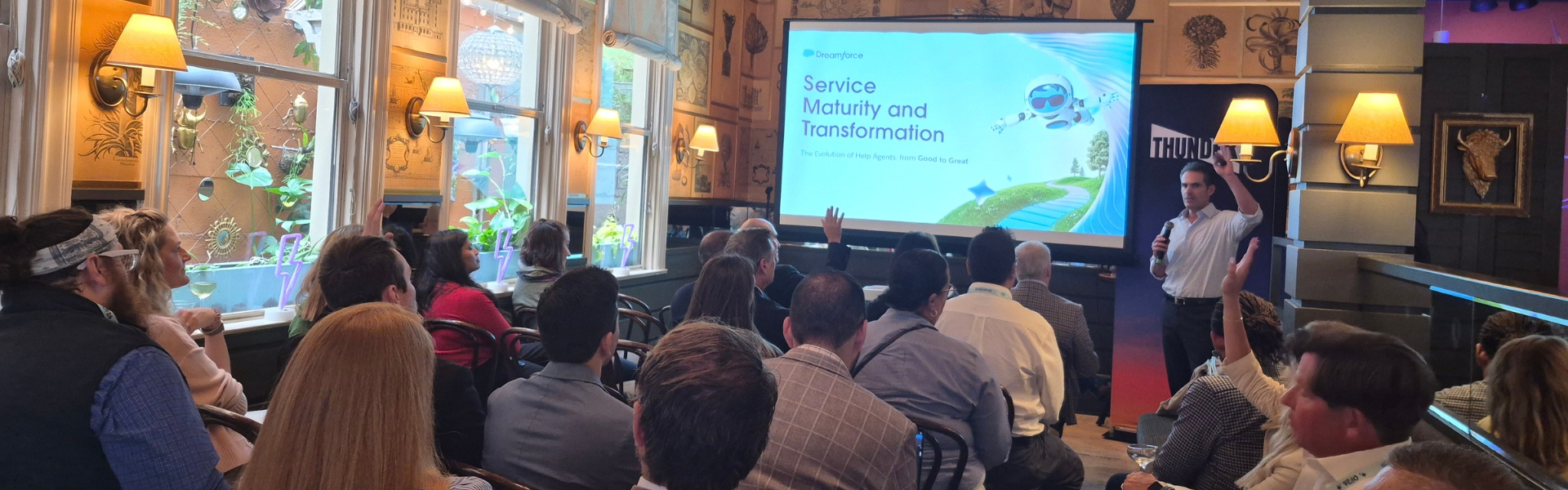
During Dreamforce week, everyone in service wanted to talk about AI agents. Far fewer wanted to talk about what has to be true before an agent can deliver. That gap was the focus of the Good to Great Service Transformation session Thunder hosted on September 16 at The Fly Trap in San Francisco.
I was joined by Matt Kravitz, VP of Product Management at Salesforce, to walk a room of service and contact center leaders through a maturity framework for getting real business impact from AI. Our core message: great service doesn't start with the agent. It starts with a clear service model and a foundation built one pillar at a time. Here's a recap.
Start with your service model
Before picking channels or tools, you need to know what kind of service organization you are. We grouped service models into three patterns, and each one has a different definition of success:
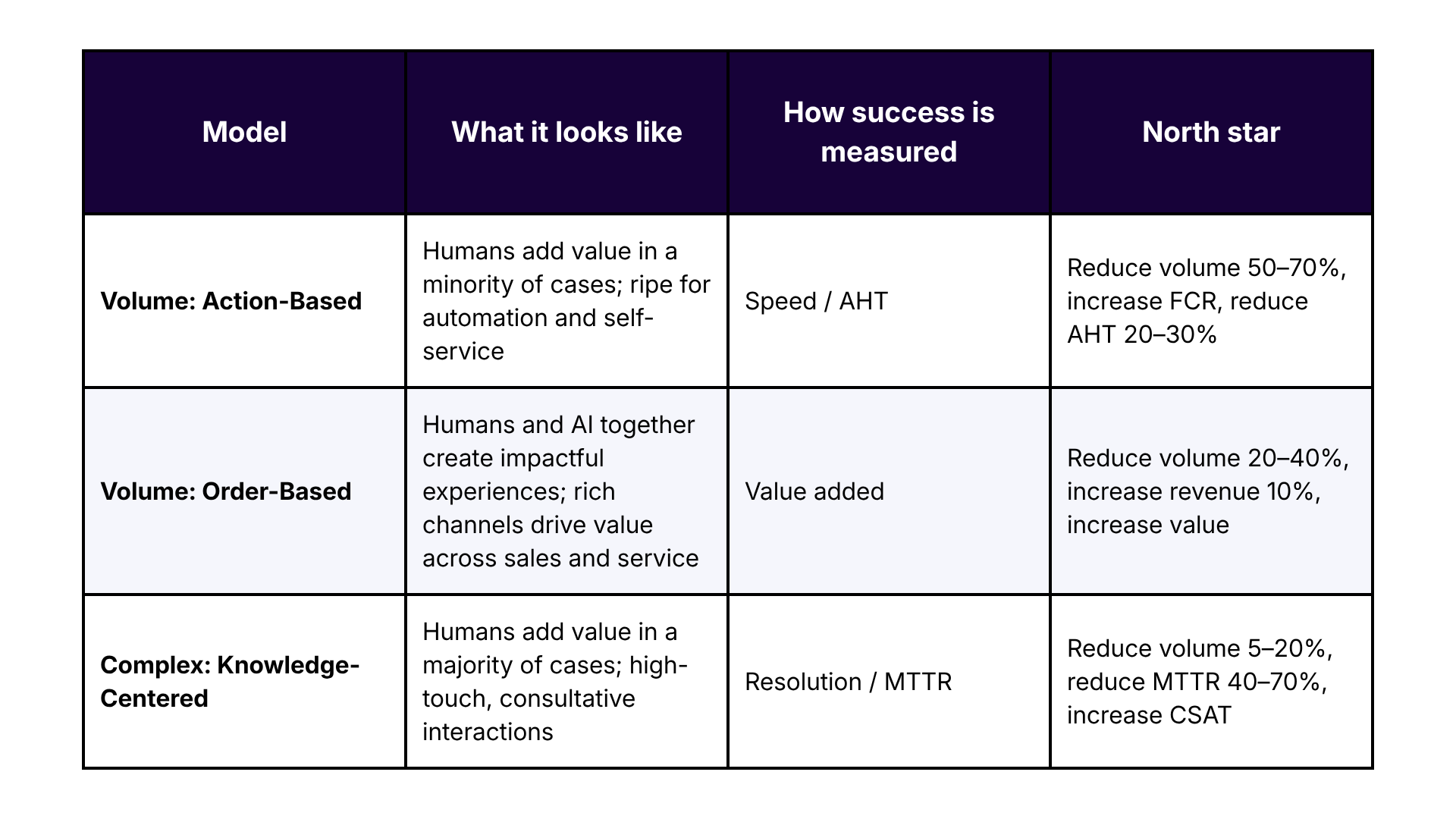
The model tells you where to put your AI investment. Action-based organizations should focus on agentic self-service actions. Order-based and knowledge-centered organizations get more from augmenting their reps and technicians with contextual guidance, summarization and AI-drafted replies.
One of the most important points of the session: most organizations see themselves in all three buckets, and that's fine. But trying to make more than one of them your major focus leads to stagnation and mediocrity. Pick your primary model and build around it.
The five pillars of service maturity
Once you know your model, maturity comes down to five pillars. Each one has its own three-level journey from good to great.
1. Channel strategy: from presence to intelligence
It starts with one question: why do customers contact us? Identify your top 6–10 contact drivers, then assign each to a deliberate engagement approach: no-touch (self-service), low-touch (digital) or high-touch (voice). Order status belongs in self-service. Product questions may deserve a person.
This prompts a useful debate about "could vs. should." Just because you can deflect a contact doesn't mean you should, especially where humans add real value.
The maturity path runs from Channel of Choice (every channel offered for every intent, so customers guess which is fastest) to an Intelligent Front Door (ask "why" first, then offer self-service and the right channels) to an Agentic Portal that doesn't just recommend a channel but offers to complete the action. Our advice: dream big, but start small. Launch on your portal, replicate the logic in messaging, then scale to voice.
2. Information architecture: from library to engine of action
Most help centers are organized by product (the Manual) or by category (the Library). Both put the burden on the customer. Topic-centric sites are easy to browse, but they hand customers a "reading assignment" instead of a solution.
The most mature organizations are intent-centric. They navigate by what the customer wants to do — track a shipment, start a return, update a payment method — and launch an automated flow or agent right away. A practical tip from the session: use an LLM to draft a working baseline of your intent-based IA.
3. Search experience: from results to resolution
The customer journey often starts with search, whether on Google, your site, your help center or a GPT. Search has evolved from results (a list of keyword-matched links) to answers (direct, grounded responses based on meaning) to conversation (multi-turn reasoning that can take action or hand off with context). Complex organizations, Salesforce included, typically need a hybrid of all three to serve diverse audiences.
4. Help agents: from deflection to resolution
Help agent maturity follows three A's. Take a customer asking, "What's the status of my order?"
- Answer: a generic response from knowledge ("Go to My Account and look for the Order section").
- Access: a contextual answer grounded in authenticated data ("Your order has shipped!").
- Action: orchestrated resolution ("Do you need to return or change your order?").
Each contact driver may call for a different level. The real question is where you sit today on the spectrum from answerability to actionability.
5. Omni-presence: from siloed bots to an agent workforce
Many organizations start with an AI agent in a single chat widget. Expanding to more surfaces often creates a walled experience: separate bots with separate logic, so nothing carries over between text and voice. The goal is a unified workforce: one reasoning engine that orchestrates actions across channels, portals and voice, so a customer can start on one channel and finish on another.
Where do you land? The 15-step report card
We closed by bringing it all together in a single report card. Across the five pillars, each of the three levels is a step forward, for 15 steps in total:
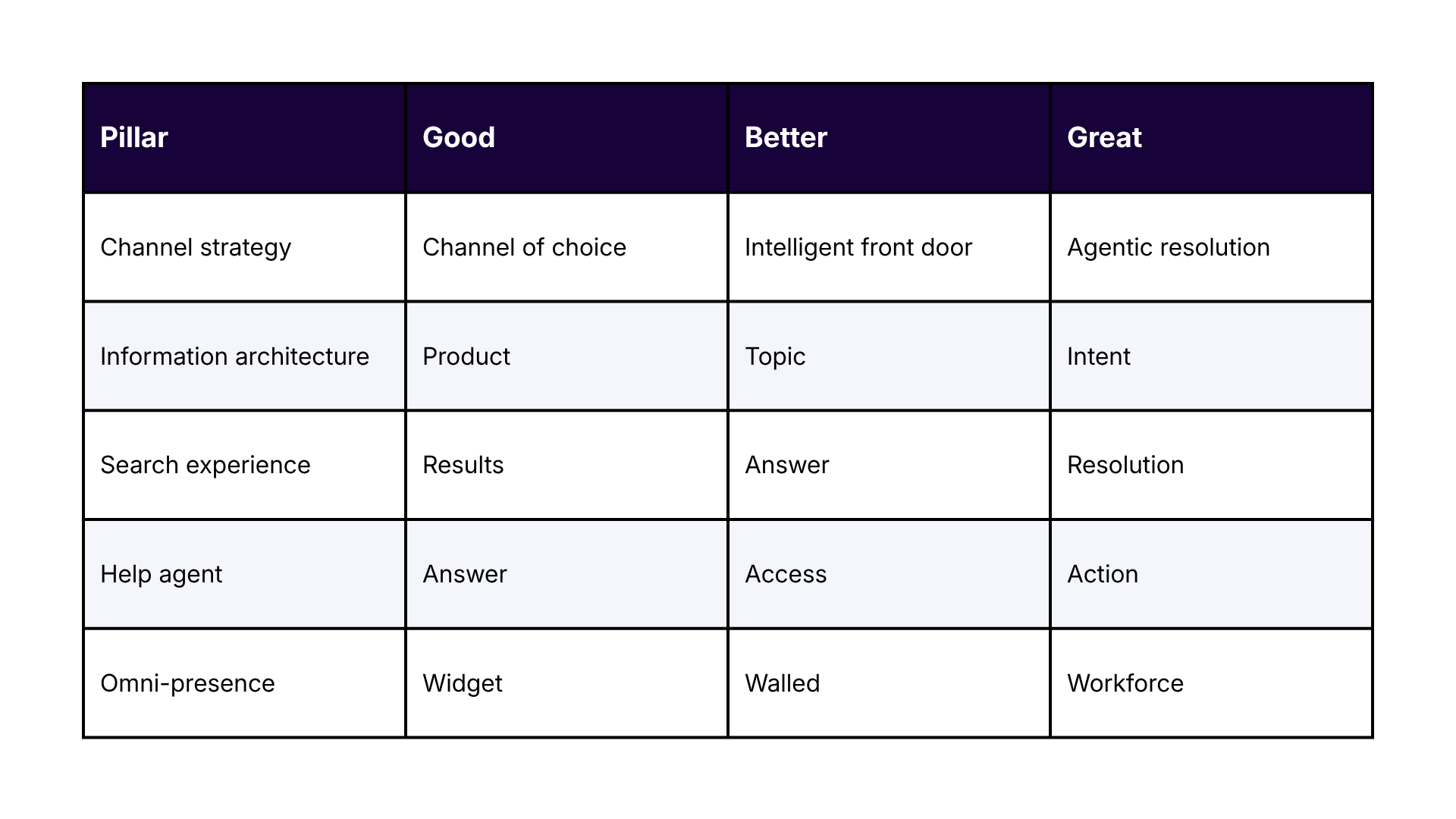
Matt also shared how Salesforce is putting this into practice with Casey, its help agent on help.salesforce.com, which reached a 70% autonomous resolution rate as of June 2026. It's a strong proof point for what's possible when the foundation is in place.
The biggest takeaway? Going from good to great isn't about adding more AI. It's about knowing your service model, maturing each pillar on purpose, and moving every contact driver from deflection to true resolution.
Get your own service maturity report card
Want to see where your organization stands? Thunder and Salesforce are offering a free, personalized Good to Great Workshop. In four hours, virtual or in person, we'll assess your service operations, score your maturity across all five pillars, benchmark your report card against industry standards, and build a phased, prioritized action plan for your team.
Related Articles
Dreamforce 2026 Session Recap: From Good to Great Service Transformation
At Dreamforce 2026, Yaron Wilf and Salesforce’s Matt Kravitz showed service leaders why great service starts with a clear service model, not an AI agent. Get the five-pillar framework and the 15-step report card.

What Can You Show Me in 90 Days? The New Standard for Federal Modernization
Federal leaders are asking a new question: what can you show me in 90 days? Learn how modernization expectations are changing, and five ways agencies can deliver measurable mission value faster.
Dreamforce 2026 Takeaways: Q&A with Paul Chesek
Now that the dust has settled on Dreamforce 2026, Paul Chesek, GM of Thunder’s Salesforce Practice, reflects on the agentic shift, the questions customers kept asking, and how Thunder is turning this year’s momentum into results.

Ready to experience
the Thunder difference?
Talk to an expert