Is SaaS dead? Not if you’ve done the math.
If you spend any time in CIO conversations, or just scrolling LinkedIn, you’ve seen the debate. Satya Nadella said it. Analysts are writing about it. The question is everywhere: Is SaaS dead?
I hear it constantly, across federal and commercial clients alike. What they say sounds something like this: "We have Salesforce, but I'm wondering what we could do with OpenAI instead. Or Anthropic. Or Bedrock." The implication is always the same: AI’s arrival will make platforms like Salesforce, Workday, and ServiceNow obsolete. They want to use any alternative possible vs "build all 'CRM' on Salesforce." However, it's more about using OpenAI + Salesforce, or Workday + Anthropic.
Here's my take after years in those rooms: SaaS isn't dead. Not even close. And the reason isn't complicated. It comes down to something that doesn't change, no matter how exciting the technology gets: price.
The debate has teeth, just not where people think
To be fair, the anxiety is real. Forrester reports that $1 trillion in SaaS market cap was erased in early 2026, and 68% of tech leaders say they plan to reduce their SaaS vendor count by 20%.
Frustration with expensive implementations that haven't delivered full value is widespread and legitimate. I hear it from CIOs every week.
But frustration with how a platform was implemented is a different problem than the platform being obsolete. When a CIO asks me whether they should replace Salesforce with OpenAI, they're usually asking the wrong question. The right question is: have you actually done the math?
The math starts with buyer fundamentals
Before I dive into numbers with any CIO, I zoom out. I ask a simple question: what actually matters to you when you buy software? Not "what's exciting right now?" But “what drives the decision?”
The answer is remarkably consistent. Price. Usability. Extensibility. Data. Whether it fits your requirements. How well it scales. These fundamentals haven't changed much since enterprise software was sold on CD-ROMs. And my strong suspicion is that they won't change just because large language models entered the picture.
Much of the "SaaS is dead" conversation skips straight to capability and completely ignores cost.
The price reality check
A while back, the CIO of a large enterprise client came to me with a request: "I'm frustrated with our Salesforce CRM. Can you help me rebuild it on OpenAI?" I told him I'd look into it.
Here's what I found. A typical Salesforce CRM user—with access to the data, file storage, contracts, and knowledge bases a salesperson actually needs—runs about $125 per user per month, or $1,500 per year. When I modeled out the equivalent data environment on an LLM for a company at that client's scale, the number was closer to $10,000 per user per year. Nearly seven times the cost just for file storage, not taking into account how many times a seller per day will prompt the LLM driving up consumption. Are you really going to ask your sellers to stop prompting, searching, updating in your LLM? And that's before you factor in engineers. After all, building anything on OpenAI or Anthropic still requires people to build and maintain it.
Then there's the unpredictability problem. Companies are burning through annual AI budgets in one to two months. OpenAI's own CEO has publicly quoted a customer telling him: "My company spent my entire 2026 budget in Q1." Glean's CEO put it plainly: the cost of AI hasn't come down as buyers expected. New model releases are costing roughly twice as much per token as their predecessors.
When the CIO at another client told me the most important factor in any software decision was price, I wasn't surprised. But what might surprise him is that, right now, at enterprise scale, SaaS wins that comparison.
Just because you can doesn't mean you should
Fred Turner, CEO of health insurance company Curative, made headlines earlier this year by ditching a $600,000 Salesforce contract after vibecoding a replacement CRM in two months. A few things stood out to me about this story.
Turner himself admitted that maintenance is "definitely one of the most challenging pieces." That makes sense; a CRM system is never finished. Campaigns change, workflows evolve, reports need updating. It's an ongoing operation, not a one-time build. And the engineering talent required to keep it running isn't free.
Then there's this: Curative's Anthropic costs have been 6x-ing every month for the past six to seven months. Those are the numbers many organizations aren’t crunching when they start thinking about walking away from a SaaS contract.
Meanwhile, Salesforce has thousands of engineers who have spent 25 years building and refining the exact capabilities a health insurance company needs, including compliance and governance features that meet HIPAA requirements. That's not something you recreate in two months.
The future is SaaS plus
Last month, Salesforce and Anthropic announced Claudeforce, a deep integration that puts Claude's AI reasoning directly inside Salesforce's enterprise data, workflows, and governance systems. Anthropic CEO Dario Amodei described it simply: “Companies can point Claude at the customer information and business context that they’ve been building in Salesforce for decades, and use it to actually run and grow their businesses.”
It's also worth noting that Anthropic uses Salesforce as its own CRM. These platforms aren't in competition; they’re becoming infrastructure for each other. Global SaaS spending is still projected to grow from $318 billion in 2025 to $512 billion by 2028, even as AI investment accelerates. The industry isn’t abandoning these platforms. It’s building on top of them.
The bottom line
AI will keep advancing. New tools will keep arriving. And yes, there will likely be a true enterprise-scale competitor to Salesforce someday. But that day isn't here yet, and the companies that pause their Salesforce investments to wait for it, or abandon them to build something from scratch, are taking a real financial risk based on a premise that hasn't held up to scrutiny.
When organizations feel they're not getting full value from their Salesforce investment, the answer is rarely another platform. It’s typically a better implementation, better data, better search, better workflow. Hasn't that always been the case?
At Thunder, we work with organizations every day to get more out of the Salesforce investments they've already made, closing the gap between what they're paying for and what they're actually getting. If that sounds familiar, let's talk.
Related Articles

What Can You Show Me in 90 Days? The New Standard for Federal Modernization
Federal leaders are asking a new question: what can you show me in 90 days? Learn how modernization expectations are changing, and five ways agencies can deliver measurable mission value faster.
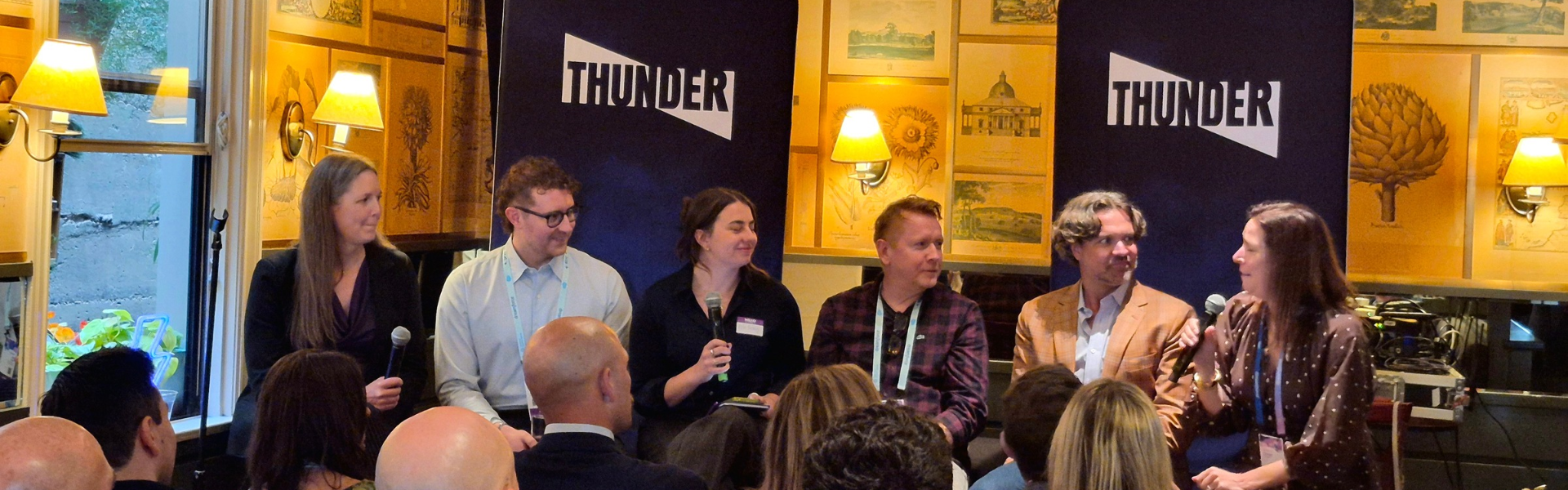
Dreamforce 2026 Takeaways: Q&A with Paul Chesek
Now that the dust has settled on Dreamforce 2026, Paul Chesek, GM of Thunder’s Salesforce Practice, reflects on the agentic shift, the questions customers kept asking, and how Thunder is turning this year’s momentum into results.

Ready to experience
the Thunder difference?
Talk to an expert